Non-invasive method to measure glucose in diabetic patients

Colloids and Surfaces B: Biointerfaces, 2024

Abstract

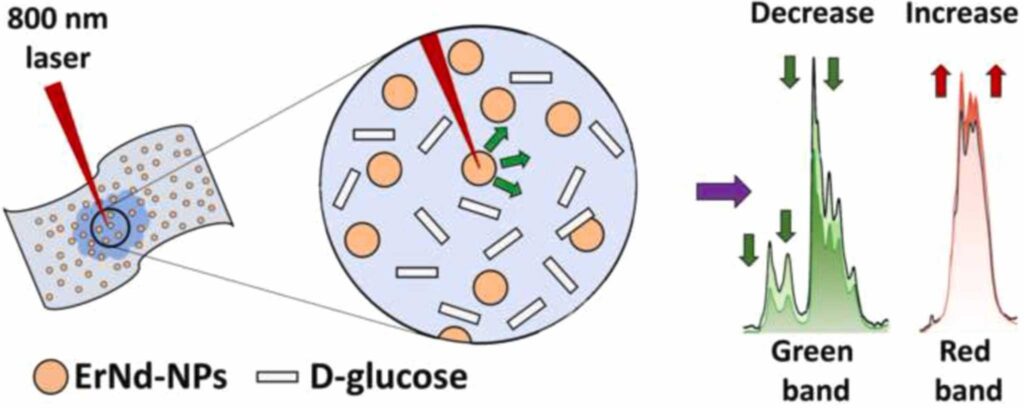
Diabetes mellitus is a common disease that requires frequent monitoring of blood glucose levels. This paper presents a new approach for a non-invasive method for the detection of glucose in patients with diabetes. This is done with the development of paper sensors based on fluorescent nanoparticles with the ability to measure small concentrations of glucose in tear fluid.

This non-invasive method represents a significant advance for glucose detection in patients with diabetes, avoiding invasive detection methods such as painful finger pricks. Using upconversion nanoparticles doped with neodymium and erbium ions, these highly sensitive tools are able to detect glucose with a limit of 22 mg/dL, being effective for the described purpose given that glucose levels in the tear fluid of diabetic patients ranges from 0 to 84 mg/dL.

This approach offers a low-cost, portable, enzyme-free sensor that has the potential to improve the quality of life of diabetic patients.

A non-invasive glucose sensor using nanoparticles, enhancing diabetes management through pain-free monitoring and improved patient convenience.

Where does it apply?

El monitoreo no invasivo de la glucosa tiene diversas aplicaciones, principalmente en la gestión de la diabetes, con el que los pacientes pueden monitorear fácilmente sus niveles de glucosa en casa y los proveedores de atención médica pueden evaluarlos con facilidad en entornos clínicos. Además este estudio da lugar a un método basado en una tecnología portátil.

La tecnología también supone un avance más en la investigación de métodos de detección por fluorescencia, gracias al empleo de los conocidos pero poco utilizados cambios en la fluorescencia de las nanopartículas, debido a su interacción con los grupos funcionales OH de la glucosa.

En general, este avance tecnológico tiene el potencial para mejorar los métodos de monitorización de la salud y supone un avance más en la investigación de la fluorescencia de nanopartículas y sus potenciales usos.
medir glucosa en pacientes diabéticos_govardhan-unsplash

Why does it matter?

Non-invasive glucose monitoring is vital for both patients and the healthcare industry. It improves the patient experience by reducing the pain of traditional finger or arm pricks, improving quality of life due to the portability of the device and the elimination of the fear associated with the tracking.

Additionally, it is worth noting that economically it has the potential to be a low-cost and easy to store monitoring method due to the use of paper as substrate and the lack of enzyme usage, both for patients and healthcare systems.

Non-invasive method to measure glucose in diabetic patients

Colloids and Surfaces B: Biointerfaces, 2024
sensor no invasivo para medir glucosa para diabetes

Other publications

Current Advances in Neural Networks
industria
Joint association of physical activity and body mass index with cardiovascular risk: a nationwide population-based cross-sectional study

Current Advances In Neural Networks

Inclusive dijet hadroproduction with a rapidity veto constraint

Joint association of physical activity and body mass index with cardiovascular risk

The article reviews neural networks’ progress emphasizing Bayesian approaches and highlights relevance in predictive analytics, customer behavior analysis, and risk management in business sectors.

The study explores parameters for perturbative expansion in particle collisions, helping in the understanding of particle physics. In the long term, this applies to fields like quantum computing, health technology, nuclear energy, and environmental monitoring.

The study refutes the 'fat but fit' paradox, stressing the importance of weight loss in combination with physical activity to alleviate risks of cardiovascular diseases.